
Do backflow issues damage your expensive pumps? System failures cause costly downtime for your entire plant. You can fix this by choosing the right one-way valve for your exact pipeline needs. The main types of check valves include swing, dual disc, ball, piston, and spring valves. These valves allow fluid to flow in one direction and block reverse flow. Selecting the correct valve depends entirely on your system pressure, fluid media, and available installation space.
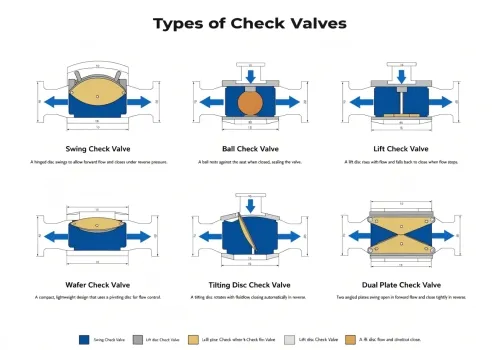
Knowing your valve options is the first step to building a safe pipeline. Read on to find out which valve matches your next big project so you do not buy the wrong part.
Heavy debris can clog standard valves easily. Blockages lead to pipe bursts and ruined equipment. A swing design uses a simple hinged door to let solids pass safely. A swing check valve uses a hinged disc that swings open with forward flow and drops shut when the flow stops. This design causes very low pressure drop. It is best for water and wastewater systems where fast closure is not required.
At Eflow Valve, we deal with large-scale water projects every day. I remember a major municipal wastewater project we supplied in Turkey last year. The local EPC contractor faced severe water hammer issues. We suggested they use specific swing check valves with external dampeners. The hinged disc inside moves completely out of the flow path. This creates a full bore opening. You get almost no resistance. This matters a lot when you move thick slurry or raw sewage. I often tell purchasing managers to watch out for the installation angle. You must install them horizontally or in vertical lines with upward flow only. Gravity does the work to close the disc. If you install them wrong, they will not shut. The local team in Turkey fixed their pipeline issues immediately after applying this advice.
| Material | Best Application | Cost Level |
|---|---|---|
| Cast Iron | Basic water lines | Low |
| Stainless Steel | Corrosive media | High |
| Ductile Iron | High-pressure water | Medium |
Tight pipe spaces make valve fitting hard. Bulky valves require you to alter your whole layout. A dual disc valve solves this space problem instantly. A dual disc check valve features two semicircular doors on a central hinge. A spring forces the doors shut before backflow starts. This wafer-style design is very compact and lightweight, making it perfect for tight spaces and pump discharge lines.
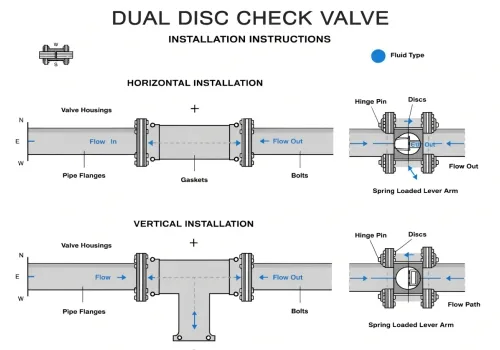
Finding space in a packed plant room is a nightmare. I had a client in South Africa building a massive HVAC pumping station. They had no room for traditional flanged valves. We shipped them a batch of dual disc check valves. These wafer-style valves fit right between two standard flanges. The spring inside these valves acts fast. It slams the doors shut the moment the pump stops. This quick action stops the water from slamming back. You avoid dangerous water hammer entirely. Many engineers overlook the weight savings. A dual door valve weighs about one-fifth of a standard swing valve. This makes installation very easy for your field workers. They do not need heavy cranes to lift them into place.
| Feature | Dual Disc Valve | Swing Valve |
|---|---|---|
| Weight | Very light | Very heavy |
| Space Needed | Minimal | Large |
| Closing Speed | Very fast | Slower |
Sticky fluids ruin complex valve parts fast. Broken springs mean full system shutdowns and angry clients. A ball check valve removes fragile parts to keep thick fluids moving. A ball check valve uses a free-floating sphere to block reverse flow. The ball lifts upward when fluid pushes it. It falls back into the seat when flow stops. This simple design is highly durable and ideal for thick liquids and wastewater.
When you handle dirty water, you need simple tools. I see many EPC buyers buy complex valves for simple dirty water lines. The valves break down within months. At Eflow Valve, we always recommend the ball type for these tough jobs. There are no hinges or pins to break. The ball spins as the fluid passes around it. This spinning action cleans the ball constantly. Dirt and grit cannot stick to the surface. You get a perfect seal every time the ball drops. The inside track guides the ball straight into the seat. We supplied these to a remote mining site in North Africa. The dust and heat made maintenance hard. They pumped abrasive mud daily. Our valves lasted three times longer than their previous brand.
| Ball Material | Media Type | Wear Resistance |
|---|---|---|
| Rubber Coated | Wastewater | Excellent |
| Solid Steel | High Temp Oil | Very Good |
| PTFE | Harsh Chemicals | Outstanding |
You reduce maintenance costs greatly with this design. Your team spends less time fixing broken pipes and more time building the actual project.
High-pressure steam destroys weak valve seals easily. Leaking steam costs you massive energy bills. A piston design offers the tightest seal for extreme industrial pressures. A piston check valve uses a linear sliding plug to block flow. Fluid pushes the piston up, and a spring pushes it down. This creates a very tight seal. It is best used in high-pressure steam, gas, and oil systems.
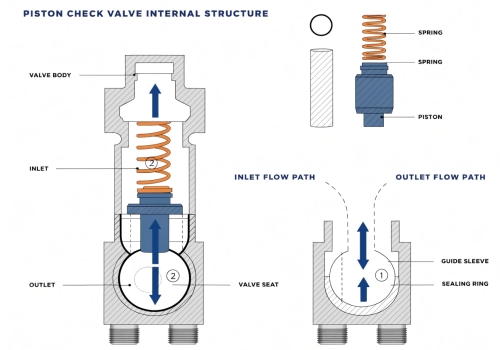
High-pressure pipelines need serious protection. Standard valves wear out quickly under pulsating flows. I work closely with purchasing managers who build power plants. They need parts that do not fail under extreme stress. Piston models are built for this exact job. The body shape looks just like a globe valve. The piston sits inside a guiding cylinder. This keeps the plug perfectly aligned at all times. The fluid creates a cushioning effect around the piston. This stops the valve from rattling inside the pipe. We sent hundreds of these to a new gas processing facility in Turkey. The plant had extreme pressure drops. We custom-built the springs to match their exact pressure needs. The spring-loaded pistons handled the shock easily.
| Condition | Valve Reaction | Result |
|---|---|---|
| High Pressure | Tight seal | Zero leaks |
| Pulsating Flow | Guided movement | No rattling |
| Vertical Pipe | Spring assisted | Instant closure |
You must install these properly to get good results. Dirt can jam the sliding piston easily. I always advise using a strainer before this valve. This small step protects your investment for many years.
There are many types of check valves for different pipeline needs. Choosing the correct one saves space, prevents equipment damage, and lowers your total project costs significantly.



 English